
1960
Africa's 5th Highest Peak
90%+
Jun – Oct and Jan – Mar
Mount Meru is one of Africa’s most rewarding high-altitude treks, offering a steep and dramatic climb inside Arusha National Park. Reaching the summit—Socialist Peak—requires excellent physical fitness, a steady head for heights, and determination to navigate a narrow, rocky crater rim, though no technical mountaineering gear is needed. The mountain is an active stratovolcano featuring a massive collapsed caldera wall and a striking, younger ash cone rising right out of the crater floor.
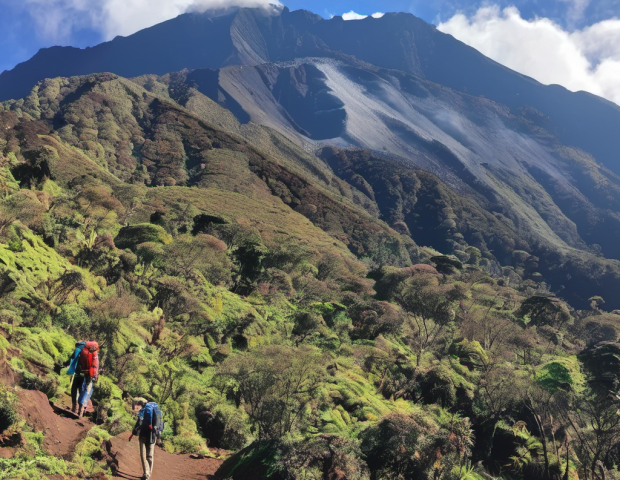
A trek up Mount Meru journeys through distinct, wildlife-rich ecological zones in just three to four days. Trekkers begin in dense montane forests—where sightings of colobus monkeys, giraffes, and buffaloes are common—before climbing through heather moorlands to reach the alpine desert near the summit. Standing as the dramatic backdrop to the city of Arusha, Mount Meru is a sanctuary for diverse wildlife and a crucial watershed for the region’s farms and communities.
Unlike Kilimanjaro, Mount Meru’s lower altitude means it tops out before reaching a true arctic zone, but it packs an incredibly dramatic transition of ecosystems and dramatic volcanic features into a much shorter distance.
Montane Forest & Cultivation (1,500m – 2,300m): The lower slopes feature fertile foothills that quickly give way to a lush, dense montane forest. Because it sits within Arusha National Park, this zone is teeming with wildlife—including spectacular black-and-white colobus monkeys, leopards, and herds of buffaloes and giraffes.
Heath & Moorland (2,300m – 3,800m): As the canopy thins, the forest transitions into giant heather zones, draped in Spanish moss. This opens up into moorlands filled with wild alpine flowers, red-hot pokers, and Meru’s own varieties of giant lobelias.
Alpine Desert (3,800m – 4,500m): A stark, dramatic, and rocky landscape where only the hardiest tufted grasses and lichens survive. Here, the trail grips the breathtaking, narrow crater rim, exposing stunning vertical drops into the caldera.
The Volcanic Summit (Above 4,500m to 4,562m): The final nighttime push to Socialist Peak is a steep, challenging scramble over volcanic scree and bare rock. Instead of glaciers, the prize here is watching the sunrise over Kilimanjaro in the distance, with the sheer cliffs of the crater wall plunging down beside you.
While Kilimanjaro is defined by its three separate peaks, Mount Meru is famous for its massive collapsed caldera. Around 7,800 years ago, a colossal explosion blew away the entire eastern wall of the mountain. Today, a spectacular, perfectly formed Ash Cone rises from the crater floor, standing inside the towering shadow of the main summit wall.
The signature primate of Mount Meru, easily spotted in the forest canopy with their long, flowing white tails.
Frequently encountered grazing on the lower mountain slopes, requiring an armed ranger to guide your trek safely.
These highly intelligent, bold birds follow trekkers up past Saddle Hut to scavenge along the crater rim.
While naturally stealthy, Meru's dense forest walls provide an ideal habitat for these beautiful big cats.
Trekkers walk right past these gentle giants in the foothills and savannah glades during the first day of the climb.
An active and playful primate commonly seen darting through the montane forest zone near Miriakamba Hut.
A brilliant iridescent-green bird that darts between giant heather stalks and feeds on alpine flower nectar.
Thousands of these pink birds color the Momella Lakes at the foot of Mount Meru, visible during your drive in.
Climbing Mount Meru is a beautifully streamlined experience. Rather than choosing between entirely different trails, your main choices are deciding how fast you want to acclimatize and which scenery you want to prioritize on day one.
The Vibe: Wildlife-heavy and highly efficient. This single route handles all traffic up the mountain, managing crowds perfectly via two well-maintained alpine hut compounds.
Technical Profile: Features a thrilling ridge walk along the narrow crater rim for the final summit push. It is physically demanding and steep, requiring a good head for heights, but requires no technical gear.
The Blueprint: You sleep in permanent wooden cabins (Miriakamba Hut and Saddle Hut) equipped with bunk beds and dining halls, meaning no tent camping is required.
While the route to the top is singular, day one offers a choice between two distinct paths that merge at Miriakamba Hut.
The Southern Approach (The Scenic Walk):
The Vibe: A longer, gentler walk that winds past the stunning Maio Waterfalls and through beautiful montane forest glades.
Highlight: It offers the highest probability of walking side-by-side with wild giraffes, buffaloes, and zebras.
The Northern Approach (The Direct Climb):
The Vibe: A shorter, steeper, and more direct path through the forest canopy.
Highlight: Great for getting to camp early, offering fantastic views of the Momella Lakes and birdlife along the way.
The 4-Day Trek (Highly Recommended): This itinerary breaks up the descent. After summiting Socialist Peak on Day 3, you drop down to Miriakamba Hut to sleep, before a relaxed walk out on Day 4. It is much easier on the knees and lets you actually enjoy the wildlife.
The 3-Day Trek (The Speed Run): You bypass the final night at Miriakamba Hut. After reaching the summit at sunrise on Day 3, you face a grueling, continuous descent of over 3,000 meters (10,000 feet) all the way back to the park gate in a single day.
Safety Note: Because Mount Meru sits entirely within a high-density wildlife zone home to large herds of Cape buffaloes and elephants, an armed park ranger must accompany every trekking group on the lower sections of the trail.
Reaching Socialist Peak is a steep test of leg endurance and mental grit. While lower than Kilimanjaro, Mount Meru actually features a steeper average incline and a much faster ascent profile, meaning you need a specific game plan to succeed.
Pole Pole (Slowly, Slowly): Even though Meru is shorter, this Swahili golden rule remains non-negotiable. Because you climb from the park gate to the summit in just 48 hours, keeping a slow, deliberate pace from day one is the only way to help your body adapt to the rapid elevation gain.
Armed Rangers & Mountain Crews: Unlike Kilimanjaro where you only trek with a standard crew, Meru requires an armed national park ranger to lead you through the wildlife-dense lower slopes. Alongside them, professional guides, chefs, and porters manage your safety, monitor your oxygen levels, and cook hot meals at the huts.
The 4-Day Itinerary Advantage: Choosing the 4-day option over the rushed 3-day trek is the single best strategy for success. It gives your legs a crucial afternoon of rest at Saddle Hut before the midnight summit push, and saves your knees from a grueling 3,000-meter continuous descent.
Mental Prep for the Crater Rim: The final push requires focus. You will be scrambling over loose volcanic rock and navigating a narrow ridge line in the dark with steep drop-offs on either side. Staying calm and taking steady, deliberate steps is key to conquering this section.
Excellent visibility and relatively clear skies. This is one of the most popular windows for summiting due to the dry weather.
Heavy rain and snow. Trails can be muddy and difficult. Recommended only for experienced trekkers seeking total solitude.
The main climbing season. Dry weather and stable conditions make this the most reliable time to reach the Uhuru Peak.
Intermittent showers mostly in the afternoons. Offers beautiful, clear mornings and far fewer hikers on the trails.
Tanzania
Tanzania